This is a SEO version of Journal of Laser Dentistry 1. Click here to view full version
« Previous Page Table of Contents Next Page »Methods
For comprehensive orthodontic treatment, most commonly, metal wires ( archwires ) are inserted into orthodontic brackets (see dental braces), which can be made from stainless steel or a more aesthetic ceramic material. The wires interact with the brackets to move teeth into the desired positions.
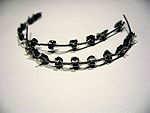
Dental braces, with a powerchain, removed after completion of treatment.
Additional components—including removable appliances ("plates"), headgear, expansion appliances, and many other devices—may also be used to move teeth and jaw bones. Functional appliances, for example, are used in growing patients (age 5 to 14) with the aim of modifying the jaw dimensions and relationship if these are altered. This therapy, termed Dentofacial Orthopedics, is frequently followed by fixed multibracket therapy ("full braces") to align the teeth and refine the occlusion.
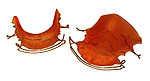
Hawley retainers are the most common type of retainers. This picture shows retainers for the top and bottom of the mouth.
After a course of active orthodontic treatment, patients will typically wear retainers, which maintain the teeth in their improved positions while surrounding bone reforms around them. The retainers are generally worn full-time for a short period, perhaps 6 months to a year, and then part-time (typically nightly during sleep) for as long as the orthodontist recommends. It is possible for the teeth to stay aligned without regular retainer wear.
However, there are many reasons teeth will crowd as a person ages, whether or not the individual ever experienced orthodontic treatment; thus there is no guarantee that teeth will stay aligned without retention. For this reason, many orthodontists prescribe part-time retainer wear for many years after orthodontic treatment.
Diagnosis and treatment planning
In diagnosis and treatment planning, the orthodontist must (1) recognize the various characteristics of a malocclusion or dentofacial deformity; (2) define the nature of the problem, including the etiology if possible;(3) design a treatment strategy based on the specific needs and desires of the individual; and (4) present the treatment strategy to the patient in such a way that the patient fully understands the ramifications of his/her decision.
Training
Orthodontics was the first recognized specialty field within dentistry. Many countries have their own systems for training and registering orthodontic specialists. A two to three year period of full-time post-graduate study is required for a dentist to qualify as an orthodontist.
Europe
In the United Kingdom, this training period lasts three years, after completion of a membership from a Royal College. A further two years is then completed to train to consultant level, after which a fellowship examination from the Royal College is sat. In other parts of Europe, a similar pattern is followed. It is always worth contacting the professional body responsible for registering orthodontists to ensure that the orthodontist you wish to consult is a recognized specialist.
This is a SEO version of Journal of Laser Dentistry 1. Click here to view full version
« Previous Page Table of Contents Next Page »