This is a SEO version of Microsoft Word - Journal of Physics.doc. Click here to view full version
« Previous Page Table of Contents Next Page »Other methods of creating a population inversion
Stimulated emission was first observed in the microwave region of the electromagnetic spectrum, giving rise to the acronym MASER for Microwave Amplification by Stimulated Emission of Radiation. In the microwave region, the Boltzmann distribution of molecules among energy states is such that, at room temperature all states are populated almost equally.
To create a population inversion under these conditions, it is necessary to selectively remove some atoms or molecules from the system based on differences in properties. For instance, in a hydrogen Maser, the well-known "21cm wave" transition in atomic hydrogen, where the lone electron flips its spin state from parallel to the nuclear spin to antiparalel, can be used to create a population inversion because the parallel state has a magnetic moment and the antiparallel state does not. A strong inhomogeneous magnetic field will separate out atoms in the higher energy state from a beam of mixed state atoms. The separated population represents a population inversion which can exhibit stimulated emissions.
Laser safety
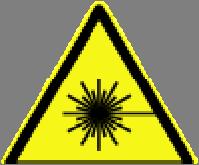
Warning symbol for lasers.
Even the first laser was recognized as being potentially dangerous. Theodore Maiman characterized the first laser as having a power of one "Gillette" as it could burn through one Gillette razor blade. Today, it is accepted that even low-power lasers with only a few milliwatts of output power can be hazardous to human eyesight, when the beam from such a laser hits the eye directly or after reflection from a shiny surface. At wavelengths which the cornea and the lens can focus well, the coherence and low divergence of laser light means that it can be focused by the eye into an extremely small spot on the retina, resulting in localized burning and permanent damage in seconds or even less time.
Lasers are usually labeled with a safety class number, which identifies how dangerous the laser is:
Class I/1 is inherently safe, usually because the light is contained in an enclosure, for example in CD players.
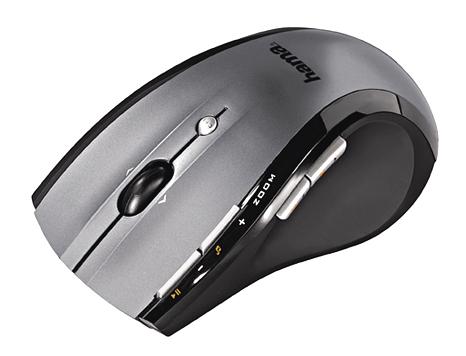
Class II/2 is safe during normal use; the blink reflex of the eye will prevent damage. Usually up to 1 mW power, for example laser pointers.
This is a SEO version of Microsoft Word - Journal of Physics.doc. Click here to view full version
« Previous Page Table of Contents Next Page »