This is a SEO version of Microsoft Word - Journal of Physics.doc. Click here to view full version
« Previous Page Table of Contents Next Page »Maser
In 1953, Charles H. Townes and graduate students James P. Gordon and Herbert J. Zeiger produced the first microwave amplifier, a device operating on similar principles to the laser — but amplifying microwave radiation, rather than infrared or visible radiations; yet, Townes's maser was incapable of continuous output. Meantime, in the Soviet Union, Nikolay Basov and Aleksandr Prokhorov were independently working on the quantum oscillator, and produced the first MASER when they solved the problem of continuous-output systems, by using more than two energy levels. These MASER systems could release stimulated emissions without falling to the ground state, thus maintaining a population inversion. In 1955, Prokhorov and Basov suggested an optical pumping of a multi-level system, as a method for obtaining the population inversion, later a main method of laser pumping.Townes reports that he was opposed by several academically eminent colleagues — among them Niels Bohr, John von Neumann, Isidor Rabi, Polykarp Kusch, and Llewellyn H. Thomas — arguing that the MASER was theoretically impossible. In 1964, Charles H. Townes, Nikolay Basov, and Aleksandr Prokhorov shared the Nobel Prize in Physics, “for fundamental work in the field of quantum electronics, which has led to the construction of oscillators and amplifiers based on the maser–laser principle”.
Laser
In 1957, Charles Hard Townes and Arthur Leonard Schawlow, then at Bell Labs, began a serious study of the infrared laser. As ideas developed, they abandoned infrared radiation to instead concentrate upon visible light. The concept originally was called an optical “maser”. In 1958, Bell Labs filed a patent application for their proposed optical maser; and Schawlow and Townes submitted a manuscript of their theoretical calculations to the Physical Review , published that year in Volume 112, Issue No. 6.
LASER notebook: First page of the notebook wherein Gordon Gould coined the LASER acronym, and described the technologic elements for constructing the device.
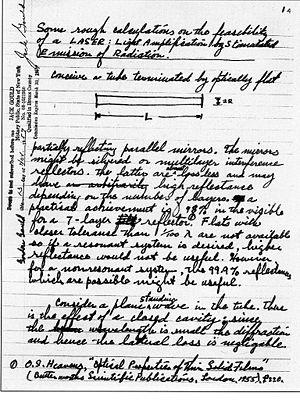
Simultaneously, at Columbia University, graduate student Gordon Gould was working on a doctoral thesis about the energy levels of excited thallium. When Gould and Townes
This is a SEO version of Microsoft Word - Journal of Physics.doc. Click here to view full version
« Previous Page Table of Contents Next Page »