This is a SEO version of Microsoft Word - Journal of Physics.doc. Click here to view full version
« Previous Page Table of Contents Next Page »• new wavelength bands
• maximum average output power
• maximum peak output power
• minimum output pulse duration
• maximum power efficiency
• maximum charging
• maximum firing
• minimum cost
and this research continues to this day.
Lasing without maintaining the medium excited into a population inversion was discovered in 1992 in sodium gas and again in 1995 in rubidium gas by various international teams. This was accomplished by using an external maser to induce "optical transparency" in the medium by introducing and destructively interfering the ground electron transitions between two paths, so that the likelihood for the ground electrons to absorb any energy has been cancelled.
Types and operating principles
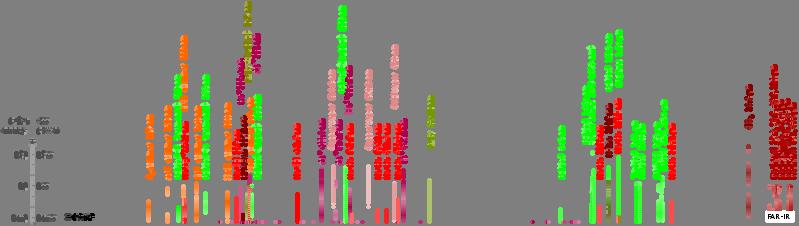

















































































Wavelengths of commercially available lasers. Laser types with distinct laser lines are shown above the wavelength bar, while below are shown lasers that can emit in a wavelength range. The color codifies the type of laser material.
Gas lasers using many gases have been built and used for many purposes.
The helium-neon laser (HeNe) emits at a variety of wavelengths and units operating at 633 nm are very common in education because of its low cost.
Carbon dioxide lasers can emit hundreds of kilowatts at 9.6 µm and 10.6 µm, and are often used in industry for cutting and welding. The efficiency of a CO
2 laser is over 10%.
Argon-ion lasers emit light in the range 351-528.7 nm. Depending on the optics and the laser tube a different number of lines is usable
but the most commonly used lines are 458 nm, 488 nm and 514.5 nm.
A nitrogen transverse electrical discharge in gas at atmospheric pressure (TEA) laser is an inexpensive gas laser producing UV light at 337.1 nm. [15]
Metal ion lasers are gas lasers that generate deep ultraviolet wavelengths. Helium-silver (HeAg) 224 nm and neon-copper (NeCu) 248 nm are two examples. These lasers have particularly narrow oscillation linewidths of less than 3 GHz (0.5 picometers), making them candidates for use in fluorescence suppressed Raman spectroscopy.
This is a SEO version of Microsoft Word - Journal of Physics.doc. Click here to view full version
« Previous Page Table of Contents Next Page »