This is a SEO version of Microsoft Word - Journal of Physics.doc. Click here to view full version
« Previous Page Table of Contents Next Page »The wavelength of an excimer laser depends on the molecules used, and is usually in the ultraviolet:
Uses
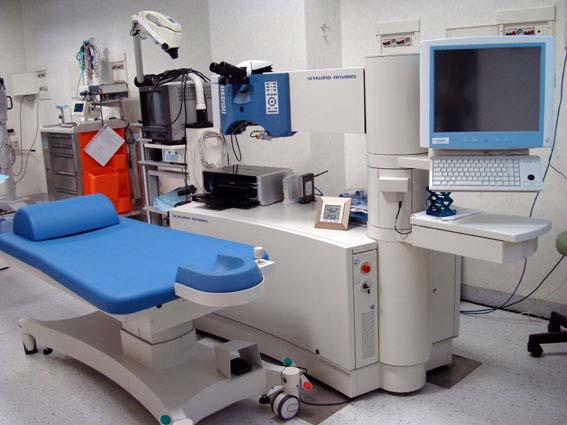
The high-power ultraviolet output of excimer lasers makes them useful for surgery (particularly eye surgery), for lithography for semiconductor manufacturing, and for dermatological treatment. Excimer laser light is typically absorbed within the first billionth of a meter (nanometer) of tissue.
In 1980 - 1983, Dr. Samuel Blum was working with Dr. Rangaswamy Srinivasan and Dr. James Wynne at IBM’s T. J. Watson Research Center when they observed the effect of the ultraviolet excimer laser on biological materials. Intrigued, they investigated further, finding that the laser made clean, precise cuts that would be ideal for delicate surgeries. This resulted in a fundamental patent and Drs. Blum, Srinivasan, and Wynne were elected to the National Inventors Hall of Fame in 2002. Subsequent work introduced the excimer laser for use in angioplasty. Kansas State University pioneered the study of the excimer laser which made LASIK surgery possible
Excimer lasers are quite large and bulky devices, which is a disadvantage in their medical applications, although their size is rapidly decreasing with ongoing development.
Xenon chloride 308-nm excimer lasers can treat a variety of dermatological conditions including psoriasis, vitiligo, atopic dermatitis, alopecia areata and leukoderma.
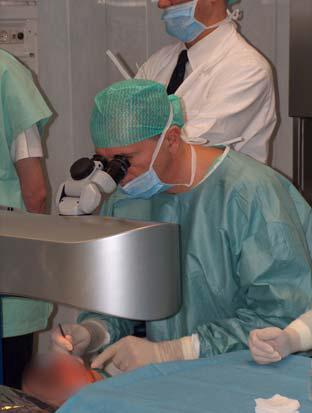
Laser - Eccimero
Lunghezza d'onda nell’ Ultravioletto
F
2 157nm
ArF 193nm
KrF 248nm
XeBr 282nm
XeCl 308nm
XeF 351nm
CaF
2 193nm
KrCl 222nm
Cl
2 259nm
This is a SEO version of Microsoft Word - Journal of Physics.doc. Click here to view full version
« Previous Page Table of Contents Next Page »