This is a SEO version of Microsoft Word - Journal of Physics.doc. Click here to view full version
« Previous Page Table of Contents Next Page »Ruby laser
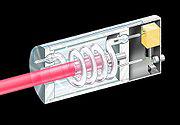
Diagram of the first ruby laser.
A ruby laser is a solid-state laser that uses a synthetic ruby crystal as its gain medium. The first working laser was a ruby laser made by Theodore H. "Ted" Maiman at Hughes Research Laboratories on May 16, 1960.
Ruby lasers produce pulses of visible light at a wavelength of 694.3 nm, which is a deep red color. Typical ruby laser pulse lengths are on the order of a millisecond.
Applications
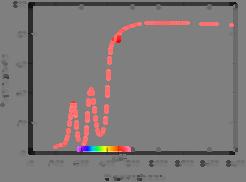
Transmittance of ruby in optical and near-IR spectra. Note the two broad blue and green absorption bands and the narrow absorption band at 694 nm, which is the wavelength of the ruby laser.

Ruby lasers have declined in use with the discovery of better lasing media. They are still used in a number of applications where short pulses of red light are required. Holographers around the world produce holographic portraits with ruby lasers, in sizes up to a
meter square. Because of its high pulsed power and good coherence length, the red 694 nm laser light is preferred to the 532 nm green light of frequency-doubled Nd:YAG, which often requires multiple pulses for large holograms. Many non-destructive testing labs use ruby lasers to create holograms of large objects such as aircraft tires to look for weaknesses in the lining. Ruby lasers were used extensively in tattoo and hair removal, but are being replaced by alexandrite lasers and Nd:YAG lasers in this application.
Design
A ruby laser rod. Inset: The view through the rod is crystal clear.
See also: Laser construction
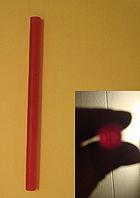
The ruby laser is a three level solid state laser. The active laser medium (laser gain/amplification medium) is a synthetic ruby rod that is energized through optical pumping, typically by a xenon flash lamp. In early examples, the rod's ends had to be polished with great precision, such that the ends of the rod were flat to within a quarter of a wavelength of the output light, and parallel to each other within a few seconds of arc. The finely polished ends of the rod were silvered: one end completely, the other only partially. The rod with its reflective ends then acts as a Fabry–Pérot etalon (or a Gires-Tournois etalon). Modern lasers often use rods with ends cut and polished at Brewster's angle instead. This eliminates the reflections from the ends of the rod; external dielectric mirrors then are used to form the optical cavity. Curved mirrors are typically used to relax the alignment tolerances.
This is a SEO version of Microsoft Word - Journal of Physics.doc. Click here to view full version
« Previous Page Table of Contents Next Page »