This is a SEO version of Microsoft Word - Journal of Physics.doc. Click here to view full version
« Previous Page Table of Contents Next Page »providing the main beams for gravitational wave interferometers such as LIGO, VIRGO, GEO600 and TAMA.
Medicine Applications
Ophthalmology
Slit lamp photo of Posterior capsular opacification visible few months after implantation of intraocular lens in eye, seen on retroillumination
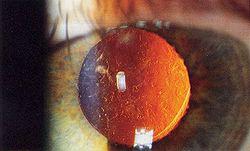
Nd:YAG lasers are used in ophthalmology to correct posterior capsular opacification, a complication of cataract surgery, and for peripheral iridotomy in patients with acute angle-closure glaucoma, where it has superseded surgical iridectomy. Frequency-doubled Nd:YAG lasers (wavelength 532 nm) are used for pan-retinal photocoagulation in patients with diabetic retinopathy.
Oncology
In oncology, Nd:YAG lasers can be used to remove skin cancers.
Cosmetic medicine
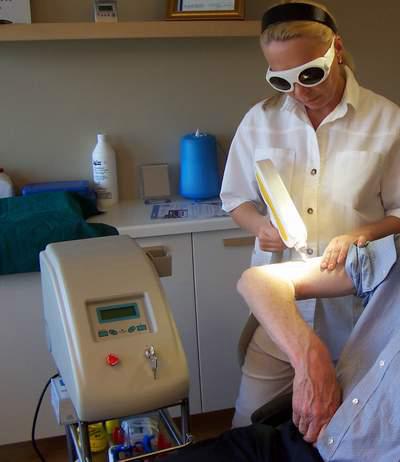
These lasers are also used extensively in the field of cosmetic medicine for laser hair removal and the treatment of minor vascular defects such as spider veins on the face and legs.
Manufacturing

Nd:YAG lasers are also used in manufacturing for engraving, etching, or marking a variety of metals and plastics. They are extensively used in manufacturing for cutting and welding steel and various alloys. For automotive applications (cutting and welding steel) the power levels are typically 1-5 kW. Super alloy drilling (for gas turbine parts) typically uses pulsed Nd:YAG lasers (millisecond pulses, not Q-switched). Nd:YAG lasers are also employed to make subsurface markings in transparent materials such as glass or acrylic glass.
This is a SEO version of Microsoft Word - Journal of Physics.doc. Click here to view full version
« Previous Page Table of Contents Next Page »