This is a SEO version of Microsoft Word - Journal of Physics.doc. Click here to view full version
« Previous Page Table of Contents Next Page »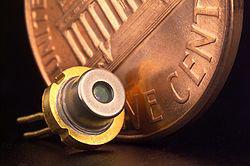
A packaged laser diode with penny for scale.
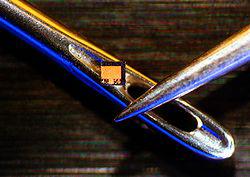
Image of the actual laser diode chip (shown on the eye of a needle for scale) contained within the package shown in the above image.
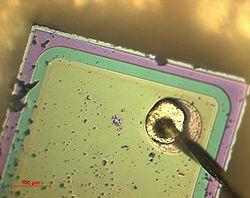
This is a visible light micrograph of a laser diode taken from a CD-ROM drive. Visible are the P and N layers distinguished by different colours. Also visible are scattered glass fragments from a broken collimating lens.
A laser diode is a laser where the active medium is a semiconductor similar to that found in a light-emitting diode. The most common and practical type of laser diode is formed from a p-n junction and powered by injected electric current. These devices are sometimes referred to as injection laser diodes to distinguish them from (optically) pumped
laser diodes , which are more easily manufactured in the laboratory.
Theory of operation
A laser diode, like many other semiconductor devices, is formed by doping a very thin layer on the surface of a crystal wafer. The crystal is doped to produce an n-type region and a p-type region, one above the other, resulting in a
p - n junction, or diode.
Laser diodes form a subset of the larger classification of semiconductor p - n junction diodes. As with any semiconductor p - n junction diode, forward electrical bias causes the two species of charge carrier - holes and electrons - to be "injected" from opposite sides of the p - n junction into the depletion region, situated at its heart. Holes are injected from the p -doped, and electrons from the n -doped, semiconductor. (A depletion region, devoid of any charge carriers, forms automatically and unavoidably as a result of the difference in chemical potential between
n - and p -type semiconductors wherever they are in physical contact.)
As charge injection is a distinguishing feature of diode lasers as compared to all other lasers, diode lasers are traditionally and more formally called "injection lasers." (This terminology differentiates diode lasers, e.g., from flashlamp-pumped solid state lasers, such as the ruby laser. Interestingly, whereas the term "solid-state" was extremely apt in differentiating 1950s-era semiconductor electronics from earlier generations of vacuum electronics, it would not have been adequate to convey unambiguously the unique characteristics defining 1960s-era semiconductor lasers.) When an electron and a hole are present in the same region, they may recombine or "annihilate" with the result being spontaneous emission — i.e., the electron may re-occupy the energy state of the hole, emitting a photon with energy equal to the difference between the electron and hole states involved. (In a conventional semiconductor junction diode, the energy released from the recombination of electrons and holes is carried away as phonons, i.e., lattice vibrations, rather than as photons.) Spontaneous emission gives the laser diode
This is a SEO version of Microsoft Word - Journal of Physics.doc. Click here to view full version
« Previous Page Table of Contents Next Page »