This is a SEO version of Microsoft Word - Journal of Physics.doc. Click here to view full version
« Previous Page Table of Contents Next Page »based lasers. This process, too, has never been disclosed as of June, 2006.
Reliability of high-power diode laser pump bars (employed to pump solid state lasers) remains a difficult problem in a variety of applications, in spite of these proprietary advances. Indeed, the physics of diode laser failure is still being worked out and research on this subject remains active, if proprietary.
Extension of the lifetime of laser diodes is critical to their continued adaptation to a wide variety of applications.
Applications of laser diodes
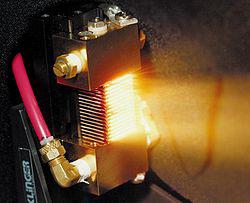
Laser diodes can be arrayed to produce very high power (continuous wave or pulsed) outputs. Such arrays may be used to efficiently pump solid state lasers for inertial confinement fusion or high average power drilling or burning applications.
Laser diodes are numerically the most common type of laser, with 2004 sales of approximately 733 million diode lasers, as compared to 131,000 of other types of lasers.
Laser diodes find wide use in telecommunication as easily modulated and easily coupled light sources for fiber optics communication. They are used in various measuring instruments, such as rangefinders. Another common use is in barcode readers. Visible lasers, typically red but later also green, are common as laser pointers. Both low and high-power diodes are used extensively in the printing industry both as light sources for scanning (input) of images and for very high-speed and high-resolution printing plate (output) manufacturing. Infrared and red laser
diodes are common in CD players, CD-ROMs and DVD technology. Violet lasers are used in HD DVD and Blu-ray technology. Diode lasers have also found many applications in laser absorption spectrometry (LAS) for high-speed, low-cost assessment or monitoring of the concentration of various species in gas phase. High-power laser diodes are used in industrial applications such as heat treating, cladding, seam welding and for pumping other lasers, such as diode pumped solid state lasers.
Applications of laser diodes can be categorized in various ways. Most applications could be served by larger solid state lasers or optical parametric oscillators, but the low cost of mass-produced diode lasers makes them essential for mass-market applications. Diode lasers can be used in a great many fields; since light has many different properties (power, wavelength and spectral quality, beam quality, polarization, etc.) it is interesting to classify applications by these basic properties.
Many applications of diode lasers primarily make use of the "directed energy" property of an optical beam. In this category one might include the laser printers, bar-code readers, image scanning, illuminators, designators, optical data recording, combustion ignition, laser surgery, industrial sorting, industrial machining, and directed energy weaponry. Some of these applications are emerging while others are well-established.
Laser medicine: medicine and especially dentistry have found many new applications for diode lasers. The shrinking size of the units and their increasing user friendliness makes them very attractive to clinicians for minor soft tissue procedures. The 800 nm - 980 nm units have a high absorption rate for hemoglobin and thus make them ideal for soft tissue applications, where good hemostasis is necessary.
Applications which may today or in the future make use of the coherence of diode-laser-generated light include interferometric distance measurement, holography, coherent communications, and coherent control of chemical reactions.
This is a SEO version of Microsoft Word - Journal of Physics.doc. Click here to view full version
« Previous Page Table of Contents Next Page »