This is a SEO version of Microsoft Word - Journal of Physics.doc. Click here to view full version
« Previous Page Table of Contents Next Page »Principle of operation
An optical fiber is a cylindrical dielectric waveguide (nonconducting waveguide) that transmits light along its axis, by the process of total internal reflection. The fiber consists of a
core surrounded by a cladding layer, both of which are made of dielectric materials. To confine the optical signal in the core, the refractive index of the core must be greater than that of the cladding. The boundary between the core and cladding may either be abrupt, in step-index fiber , or gradual, in
graded-index fiber .
Index of refraction
The index of refraction is a way of measuring the speed of light in a material. Light travels fastest in a vacuum, such as outer space. The actual speed of light in a vacuum is about 300 million meters (186 thousand miles) per second. Index of refraction is calculated by dividing the speed of light in a vacuum by the speed of light in some other medium. The index of refraction of a vacuum is therefore 1, by definition. The typical value for the cladding of an optical fiber is 1.46. The core value is typically 1.48. The larger the index of refraction, the slower light travels in that medium. From this information, a good rule of thumb is that signal using optical fiber for communication will travel at around 200 million meters per second. Or to put it another way, to travel 1000 kilometers in fiber, the signal will take 5 milliseconds to propagate. Thus a phone call carried by fiber between Sydney and New York, a 12000 kilometer distance, means that there is an absolute minimum delay of 60 milliseconds (or around 1/16th of a second) between when one caller speaks to when the other hears. (Of course the fiber in this case will probably travel a longer route, and there will be additional delays due to communication equipment switching and the process of encoding and decoding the voice onto the fiber).
Total internal reflection
When light traveling in a dense medium hits a boundary at a steep angle (larger than the "critical angle" for the boundary), the light will be completely reflected. This effect is
used in optical fibers to confine light in the core. Light travels along the fiber bouncing back and forth off of the boundary. Because the light must strike the boundary with an angle greater than the critical angle, only light that enters the fiber within a certain range of angles can travel down the fiber without leaking out. This range of angles is called the acceptance cone of the fiber. The size of this acceptance cone is a function of the refractive index difference between the fiber's core and cladding.
In simpler terms, there is a maximum angle from the fiber axis at which light may enter the fiber so that it will propagate, or travel, in the core of the fiber. The sine of this maximum angle is the numerical aperture (NA) of the fiber. Fiber with a larger NA requires less precision to splice and work with than fiber with a smaller NA. Single-mode fiber has a small NA.
Multi-mode fiber

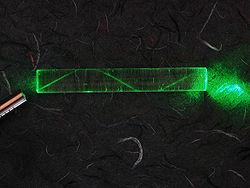

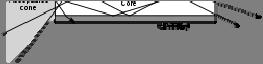
A laser bouncing down an acrylic rod, illustrating the total internal reflection of light in a multi-mode optical fiber.
Fiber with large core diameter (greater than 10 micrometers) may be analyzed by geometrical optics. Such fiber is called multi-mode fiber , from the electromagnetic analysis (see below). In a step-index multi-mode fiber, rays of light are guided along the fiber core by total internal reflection. Rays that meet the
This is a SEO version of Microsoft Word - Journal of Physics.doc. Click here to view full version
« Previous Page Table of Contents Next Page »