This is a SEO version of Journal of Laser Dentistry 1. Click here to view full version
« Previous Page Table of Contents Next Page »of periodontitis are periodontists; their field is known as "periodontology" or "periodontics".
The word "periodontitis" comes from peri ("around"), odont ("tooth") and - itis ("inflammation").
Classification
The 1999 classification system for periodontal diseases and conditions listed seven major categories of periodontal diseases, of which the last six are termed destructive periodontal disease because they are essentially irreversible. The seven categories are as follows:
1. Gingivitis
2. Chronic periodontitis 3. Aggressive periodontitis
4. Periodontitis as a manifestation of systemic disease
5. Necrotizing ulcerative gingivitis/periodontitis 6. Abscesses of the periodontium 7. Combined periodontic-endodontic lesions
Moreover, terminology expressing both the extent and severity of periodontal diseases are appended to the terms above to denote the specific diagnosis of a particular patient or group of patients.
Extent
The extent of disease refers to the proportion of the dentition affected by the disease in terms of percentage of sites. Sites are defined as the positions at which probing measurements are taken around each tooth and, generally, six probing sites around each tooth are recorded, as follows:
1. mesiobuccal 2. mid-buccal 3. distobuccal 4. mesiolingual 5. mid-lingual 6. distolingual
If up to 30% of sites in the mouth are affected, the manifestation is classification as
localized ; for more than 30%, the term
generalized is used.
Severity
The severity of disease refers to the amount of periodontal ligament fibers that have been lost, termed clinical attachment loss . According to the American Academy of Periodontology, the classification of severity is as follows:
• Mild : 1–2 mm of attachment loss
• Moderate : 3–4 mm of attachment loss
• Severe : ≥ 5 mm of attachment loss
Signs and symptoms
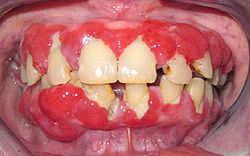
Periodontitis manifesting as painful, red, swollen gums, with abundant plaque.
In the early stages, periodontitis has very few symptoms and in many individuals the disease has progressed significantly before they seek treatment. Symptoms may include the following:
Redness or bleeding of gums while brushing teeth, using dental floss or biting into hard food (e.g. apples) (though this may occur even in gingivitis, where there is no attachment loss)
Gum swelling that recurs
Halitosis, or bad breath, and a persistent metallic taste in the mouth
Gingival recession, resulting in apparent lengthening of teeth. (This may also be
This is a SEO version of Journal of Laser Dentistry 1. Click here to view full version
« Previous Page Table of Contents Next Page »