This is a SEO version of Journal of Laser Dentistry 1. Click here to view full version
« Previous Page Table of Contents Next Page »caused by heavy handed brushing or with a stiff tooth brush.)
Deep pockets between the teeth and the gums (pockets are sites where the attachment has been gradually destroyed by collagen-destroying enzymes, known as collagenases )
Loose teeth, in the later stages (though this may occur for other reasons as well)
Patients should realize that the gingival inflammation and bone destruction are largely painless. Hence, people may wrongly assume that painless bleeding after teeth cleaning is insignificant, although this may be a symptom of progressing periodontitis in that patient.
Effects outside the mouth
Periodontitis has been linked to increased inflammation in the body such as indicated by raised levels of C-reactive protein and Interleukin-6. It is through this linked to increased risk of stroke, myocardial infarction, and atherosclerosis. It also linked in those over 60 years of age to impairments in delayed memory and calculation abilities.
Cause
Periodontitis is an inflammation of the periodontium—the tissues that support the teeth. The periodontium consists of four tissues:
gingiva, or gum tissue;
cementum, or outer layer of the roots of teeth;
alveolar bone, or the bony sockets into which the teeth are anchored;
periodontal ligaments (PDLs), which are the connective tissue fibers that run between the cementum and the alveolar bone.
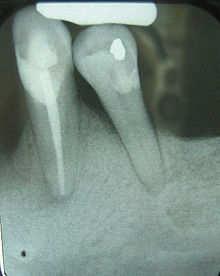
This X-ray film displays two lone-standing mandibular teeth, the lower left first premolar and canine, exhibiting severe bone loss of 30– 50%. Widening of the periodontal ligament surrounding the premolar is due to secondary occlusal trauma.
The primary etiology (cause) of gingivitis is poor oral hygiene which leads to the accumulation of a mycotic and bacterial matrix at the gum line, called dental plaque. Other contributors are poor nutrition and underlying medical issues such as diabetes. New finger nick tests have been approved by the Food and Drug Administration in the US, and are being used in dental offices to identify and screen patients for possible contributory causes of gum disease such as diabetes.
In some people, gingivitis progresses to periodontitis - with the destruction of the gingival fibers, the gum tissues separate from the tooth and deepened sulcus, called a periodontal pocket. Subgingival microorganism (those that exist under the gum line) colonize the periodontal pockets and cause further inflammation in the gum tissues and progressive bone loss. Examples of secondary etiology are those things that, by definition, cause microbic plaque accumulation, such as restoration overhangs and root proximity.
This is a SEO version of Journal of Laser Dentistry 1. Click here to view full version
« Previous Page Table of Contents Next Page »