This is a SEO version of Microsoft Word - Journal of Physics.doc. Click here to view full version
« Previous Page Table of Contents Next Page »Léon Foucault used an experiment which used rotating mirrors to obtain a value of 298,000,000 m/s in 1862. Albert A. Michelson conducted experiments on the speed of light from 1877 until his death in 1931. He refined Foucault's methods in 1926 using improved rotating mirrors to measure the time it took light to make a round trip from Mt. Wilson to Mt. San Antonio in California. The precise measurements yielded a speed of 299,796,000 m/s.
Two independent teams of physicists were able to bring light to a complete standstill by passing it through a Bose-Einstein Condensate of the element rubidium, one led by Dr. Lene Vestergaard Hau of Harvard University and the Rowland Institute for Science in Cambridge, Mass., and the other by Dr. Ronald L. Walsworth and Dr. Mikhail D. Lukin of the Harvard-Smithsonian Center for Astrophysics, also in Cambridge.
Optics
The study of light and the interaction of light and matter is termed optics. The observation and study of optical phenomena such as rainbows and the aurora borealis offer many clues as to the nature of light as well as much enjoyment.
Electromagnetic spectrum
Electromagnetic spectrum with light highlighted Generally, EM radiation (the designation 'radiation' excludes static electric and magnetic and near fields) is classified by wavelength into radio, microwave, infrared, the visible region we perceive as light, ultraviolet, X-rays and gamma rays.
The behaviour of EM radiation depends on its wavelength. Higher frequencies have shorter wavelengths, and lower frequencies have
longer wavelengths. When EM radiation interacts with single atoms and molecules, its behaviour depends on the amount of energy per quantum it carries.
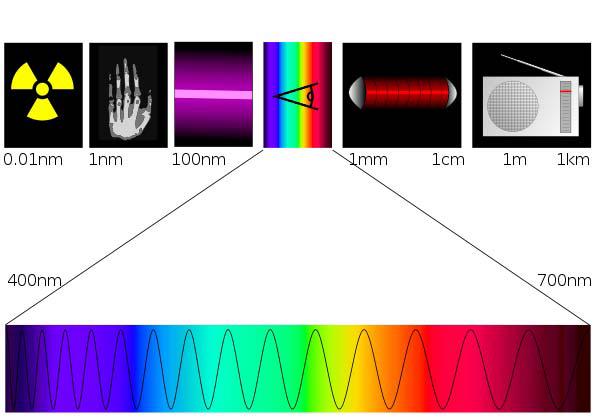
From left to right:
gamma rays, X-rays, ultraviolet rays, visible spectrum, infrared, microwaves, radio waves.
This is a SEO version of Microsoft Word - Journal of Physics.doc. Click here to view full version
« Previous Page Table of Contents Next Page »