This is a SEO version of Microsoft Word - Journal of Physics.doc. Click here to view full version
« Previous Page Table of Contents Next Page »Laser
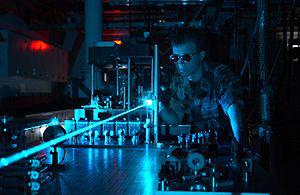
Experiment with a laser.
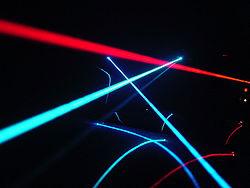
Laser beams in fog and on a car windshield
Light Amplification by Stimulated Emission of Radiation,
LASER ( laser ), is a mechanism for emitting light within the electromagnetic radiation region of the spectrum, via the process of stimulated emission. The emitted laser light is (usually) a spatially coherent, narrow low-divergence beam, that can be manipulated with lenses. In laser technology, “coherent light” denotes a light source that produces (emits) light of in-step waves of identical frequency and phase. The laser’s beam of coherent light differentiates it from light sources that emit incoherent light beams, of random phase varying with time and position; whereas the laser light is a narrow-wavelength electromagnetic spectrum monochromatic
light; yet, there are lasers that emit a broad spectrum light, or simultaneously, at different wavelengths.
Terminology
The word laser originally was the upper-case
LASER , the acronym from Light Amplification by Stimulated Emission of Radiation , wherein light broadly denotes electromagnetic radiation of any frequency, not only the visible spectrum; hence infrared laser, ultraviolet laser, X-ray laser, et cetera. Because the microwave predecessor of the laser, the maser , was developed first, devices that emit microwave and radio frequencies are denoted “masers”. In the early technical literature, especially in that of the Bell Telephone Laboratories researchers, the laser was also called optical maser , a currently uncommon term, moreover, since 1998, Bell Laboratories adopted the laser usage. Linguistically, the back-formation verb to lase means “to produce laser light” and “to apply laser light to”. The word laser sometimes is inaccurately used to describe a non-laser-light technology, e.g. a coherent-state atom source is an atom laser.
Design


Principal components: 1. Gain medium
2. Laser pumping energy 3. High reflector 4. Output coupler 5. Laser beam

This is a SEO version of Microsoft Word - Journal of Physics.doc. Click here to view full version
« Previous Page Table of Contents Next Page »