This is a SEO version of Microsoft Word - Journal of Physics.doc. Click here to view full version
« Previous Page Table of Contents Next Page »Laser construction
A laser consists of a gain medium inside a highly reflective optical cavity, as well as a means to supply energy to the gain medium. The gain medium is a material with properties that allow it to amplify light by stimulated emission. In its simplest form, a cavity consists of two mirrors arranged such that light bounces back and forth, each time passing through the gain medium. Typically one of the two mirrors, the output coupler, is partially transparent. The output laser beam is emitted through this mirror.
Light of a specific wavelength that passes through the gain medium is amplified (increases in power); the surrounding mirrors ensure that most of the light makes many passes through the gain medium, being amplified repeatedly. Part of the light that is between the mirrors (that is, within the cavity) passes through the partially transparent mirror and escapes as a beam of light.
The process of supplying the energy required for the amplification is called pumping. The energy is typically supplied as an electrical current or as light at a different wavelength. Such light may be provided by a flash lamp or perhaps another laser. Most practical lasers contain additional elements that affect properties such as the wavelength of the emitted light and the shape of the beam.
Laser physics
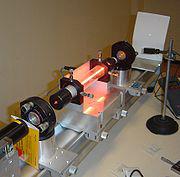
A helium-neon laser demonstration at the Kastler-Brossel Laboratory at Univ. Paris 6. The glowing ray in the middle is an electric discharge producing light in much the same way as a neon light. It is the gain medium through which the laser passes, not the laser beam itself, which is visible there. The laser beam crosses the air and marks a red point on the screen to the right.
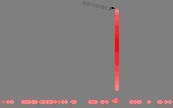
Spectrum of a helium neon laser showing the very high spectral purity intrinsic to nearly all lasers. Compare with the relatively broad spectral emittance of a light emitting diode.
The gain medium of a laser is a material of controlled purity, size, concentration, and shape, which amplifies the beam by the process of stimulated emission. It can be of any state: gas, liquid, solid or plasma. The gain medium absorbs pump energy, which raises some electrons into higher-energy ("excited") quantum states. Particles can interact with light both by absorbing photons or by emitting photons. Emission can be spontaneous or stimulated. In the latter case, the photon is emitted in the same direction as the light that is passing by. When the number of particles in one excited state exceeds the number of particles in some lower-energy state, population inversion is achieved and the amount of stimulated emission due to light that passes through is larger than the amount of absorption. Hence, the light is amplified. By itself, this makes an optical amplifier. When an optical amplifier is placed inside a resonant optical cavity, one obtains a laser.
The light generated by stimulated emission is very similar to the input signal in terms of wavelength, phase, and polarization. This
This is a SEO version of Microsoft Word - Journal of Physics.doc. Click here to view full version
« Previous Page Table of Contents Next Page »