This is a SEO version of Microsoft Word - Journal of Physics.doc. Click here to view full version
« Previous Page Table of Contents Next Page »Characteristics
of the laser radiation
Direction
Contrarily of the traditional sources the laser allows to send the radiation in an only direction.
The solid angle subtended by a laser bundle is more precisely extremely small; The solid angle , Ω , is the two-dimensional angle in three-dimensional space that an object subtends at a point. It is a measure of how large that object appears to an observer looking from that point. A small object nearby may subtend the same solid angle as a larger object farther away. An object's solid angle is equal to the area of the segment of unit sphere (centered at the vertex of the angle) restricted by the object (this definition works in any dimension, including 1D and 2D). A solid angle equals the area of a segment of unit sphere in the same way a planar angle equals the length of an arc of unit circle.
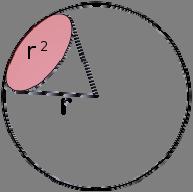
Steradian
The units of solid angle can be called steradian (abbreviated "sr") according to SI. From the point of view of mathematics and physics solid angle is dimensionless and has no units, thus "sr" should be skipped in scientific texts. The solid angle of a sphere measured from a point in its interior is 4π sr, and the solid angle subtended at the center of a cube by one of its faces is one-sixth of that, or 2π/3 sr. Solid angles can also be measured in square degrees ( 1 sr = (180/π) 2 square
degree ) or in fractions of the sphere (i.e.,
fractional area ), 1 sr = 1/4π fractional area .
One way to determine the fractional area subtended by a spherical surface is to divide the area of that surface by the entire surface area of the sphere. The fractional area can then be converted to steradian or square degree measurements by the following formulae:
1. To obtain the solid angle in steradians, multiply the fractional area by 4π. 2. To obtain the solid angle in square degrees, multiply the fractional area by 4π × (180/π) 2 , which is equal to 129600/π.
The solid angle for an arbitrary oriented surface S subtended at a point P is equal to the solid angle of the projection of the surface S to the unit sphere with center P, which can be calculated as the surface integral:
where is the vector position of an infinitesimal area of surface with respect to point P and where represents the unit vector normal to . Even if the projection on the unit sphere to the surface S is not isomorphic, the multiple folds are correctly considered according the surface orientation described by the sign of the scalar product
.
A good description of the propagation and collimation of a laser bundle is given by the optics of the gaussian beam. In optics, a
Gaussian beam is a beam of electromagnetic radiation whose transverse electric field and intensity (irradiance) distributions are described by Gaussian functions. Many lasers emit beams with a Gaussian profile, in which case the laser is said to be operating on the
fundamental transverse mode , or "TEM
00 mode" of the laser's optical resonator. When refracted by a lens, a Gaussian beam is transformed into another Gaussian beam (characterized by a different set of
This is a SEO version of Microsoft Word - Journal of Physics.doc. Click here to view full version
« Previous Page Table of Contents Next Page »