This is a SEO version of Microsoft Word - Journal of Physics.doc. Click here to view full version
« Previous Page Table of Contents Next Page »parameters), which explains why it is a convenient, widespread model in laser optics.
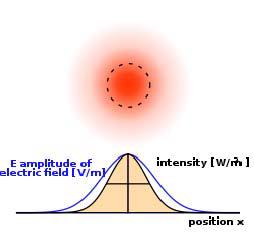

Light from a 630 nm laser pointer.
The mathematical function that describes the Gaussian beam is a solution to the paraxial form of the Helmholtz equation. The solution, in the form of a Gaussian function, represents the complex amplitude of the electric field, which propagates along with the corresponding magnetic field as an electromagnetic wave in the beam.
Compact Disc
A Compact Disc (also known as a CD ) is an optical disc used to store digital data. It was originally developed to store sound recordings exclusively, but later it also allowed the preservation of other types of data. Audio CDs have been commercially available since October 1982. In 2010, they remain the standard physical storage medium for audio.
Standard CDs have a diameter of 120 mm and can hold up to 80 minutes of uncompressed audio (700 MB of data). The Mini CD has various diameters ranging from 60 to 80 mm; they are sometimes used for CD singles or device drivers, storing up to 24 minutes of audio.
The technology was eventually adapted and expanded to encompass data storage CD-ROM, write-once audio and data storage CD-R, rewritable media CD-RW, Video Compact Discs (VCD), Super Video Compact Discs (SVCD), Photo-CD, Picture-CD, CD-i, and Enhanced CD.
CD-ROMs and CD-Rs remain widely used technologies in the computer industry. The CD and its extensions are successful: in 2004, worldwide sales of CD audio, CD-ROM, and CD-R reached about 30 billion discs. By 2007, 200 billion CDs had been sold worldwide.

This is a SEO version of Microsoft Word - Journal of Physics.doc. Click here to view full version
« Previous Page Table of Contents Next Page »