This is a SEO version of Microsoft Word - Journal of Physics.doc. Click here to view full version
« Previous Page Table of Contents Next Page »Helium–neon laser
A helium-neon laser , usually called a HeNe laser , is a type of small gas laser. HeNe lasers have many industrial and scientific uses, and are often used in laboratory demonstrations of optics. Its usual operation wavelength is 632.8 nm, in the red portion of the visible spectrum.
Schematic diagram of a helium-neon laser
The gain medium of the laser, as suggested by its name, is a mixture of helium and neon gases, in a 5:1 to 20:1 ratio, contained at low pressure He at 1torr and Ne at 0.1torr (an average 50 Pa per cm of cavity length) in a glass envelope. The energy or pump source of the laser is provided by an electrical discharge of around 1000 volts [ citation needed ] through an anode and cathode at each end of the glass tube. A current of 5 to 100 mA is typical for CW operation.. The optical cavity of the laser typically consists of a plane, high-reflecting mirror at one end of the laser tube, and a concave output coupler mirror of approximately 1% transmission at the other end.
HeNe lasers are normally small, with cavity lengths of around 15 cm up to 0.5 m, and optical output powers ranging from 1 mW to 100 mW.
The red HeNe laser wavelength is usually reported as 632nm. However, the true wavelength in air is 632.816 nm, so 633nm is actually closer to the true value. For the purposes of calculating the photon energy, the vacuum wavelength of 632.991 nm should be used. The precise operating wavelength lies within about 0.002 nm of this value, and fluctuates within this range due to thermal expansion of the cavity. Frequency stabilized versions enable the wavelength to be maintained within about 2 parts in 10 12 for months and years of continuous operation.
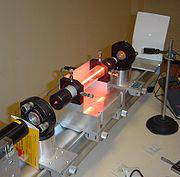
A HeNe laser demonstrated at the Kastler-Brossel Laboratory at Univ. Paris 6.
The laser process in a HeNe laser starts with collision of electrons from the electrical discharge with the helium atoms in the gas. This excites helium from the ground state to the 2 3 S
1 and 2 1 S
0 long-lived, metastable excited states. Collision of the excited helium atoms with the ground-state neon atoms results in transfer of energy to the neon atoms, exciting neon electrons into the 3s
2 level. This is due to a coincidence of energy levels between the helium and neon atoms.
This process is given by the reaction equation:
He(2 1 S)* + Ne + ΔE → He(1 1 S) + Ne3s
2 *
where (*) represents an excited state, and ΔE is the small energy difference between the energy states of the two atoms, of the order of 0.05 eV or 387 cm -1 , which is supplied by kinetic energy. The number of neon atoms entering the excited states builds up as further collisions between helium and neon atoms occur, causing a population inversion. Spontaneous and stimulated emission between the 3s
2 and 2p
4 states results in emission of 632.82 nm wavelength light, the typical operating wavelength of a HeNe laser. After this, fast radiative decay occurs from the 2p to the 1s ground state. Because the neon upper level saturates with higher current and the lower level varies linearly with current, the
This is a SEO version of Microsoft Word - Journal of Physics.doc. Click here to view full version
« Previous Page Table of Contents Next Page »