This is a SEO version of Microsoft Word - Journal of Physics.doc. Click here to view full version
« Previous Page Table of Contents Next Page »HeNe laser is restricted to low power operation to maintain population inversion.
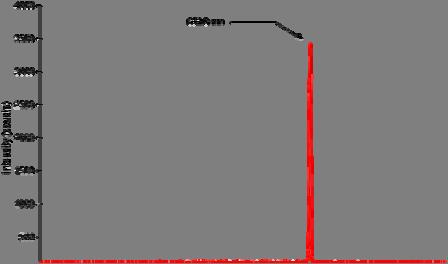









Spectrum of a helium neon laser showing the very high spectral purity intrinsic to most lasers. Compare with the relatively broad spectral emittance of a light-emitting diode.
With the correct selection of cavity mirrors, other wavelengths of laser emission of the HeNe laser are possible. There are infrared transitions at 3.39 μm and 1.15 μm wavelengths, and a variety of visible transitions, including a green (543.365 nm, the so-called GreeNe laser), a yellow (593.932 nm), a yellow-orange (604.613 nm), and an orange (611.802 nm) transition. The typical 633 nm wavelength red output of a HeNe laser actually has a much lower gain compared to other wavelengths such as the 1.15 μm and 3.39 μm lines, but these can be suppressed by choosing cavity mirrors with optical coatings that reflect only the desired wavelengths.
The gain bandwidth of the laser is dominated by Doppler broadening, and is quite narrow at around 1.5 GHz for the 633nm transitionlasing on a single longitudinal mode. The visible output of the HeNe laser, and its excellent spatial quality, makes the HeNe a useful source for holography and as a reference for spectroscopy. It is also one of the benchmark systems for the definition of the meter.
Prior to the invention of cheap, abundant diode lasers, HeNe lasers were used in barcode scanners. The HeNe laser was the first gas laser to be invented, by Ali Javan, William Bennett Jr. and Donald Herriott at Bell Labs, who in 1960 achieved continuous wave emission of the laser on the 1.15 μm wavelength line.
Ion laser
From left to right: 1 mW Uniphase HeNe on alignment-rig, 2 Watt Lexel 88 Argon Ion laser, and power-supply. To the rear are hoses for water cooling.
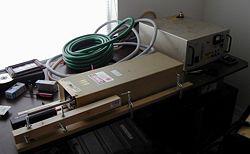
An Ion Laser is a gas laser which uses an ionized gas as its lasing medium. Like other gas lasers, ion lasers feature a sealed cavity containing the laser medium and mirrors forming a Fabry-Perot resonator. Unlike HeNe lasers, the energy level transitions that contribute to laser action come from ions. Because of the large amount of energy required to excite the ionic transitions used in ion lasers, the required current is much greater, and as a result all but the smallest ion lasers are water cooled. A small air cooled ion laser might produce, for example, 130mW of light with a tube current of 10A @ 105V. This is a total power draw over 1 kW, which translates into a large amount of heat which must be dissipated.
This is a SEO version of Microsoft Word - Journal of Physics.doc. Click here to view full version
« Previous Page Table of Contents Next Page »