This is a SEO version of Microsoft Word - Journal of Physics.doc. Click here to view full version
« Previous Page Table of Contents Next Page »Argon laser
The Argon laser was invented in 1964 by William Bridges at Hughes Aircraft and is one of a family of Ion lasers that use a noble gas as the active medium.
Argon lasers are used for retinal phototherapy (for diabetes), lithography, and pumping other lasers. Argon lasers emit at several wavelengths through the visible and ultraviolet spectrum: 351 nm, 454.6 nm, 457.9 nm, 465.8 nm, 476.5 nm, 488.0 nm, 496.5 nm, 501.7 nm, 514.5 nm, 528.7 nm.
Common argon and krypton lasers are capable of emitting continual wave output of several milliwatts to tens of watts continually. Their tubes are usually made of Nickel end bells, kovar metal to ceramic seals, beryllium oxide ceramics, or tungstendisks mounted on a copper heat spreader in a ceramic liner. The earliest tubes were simple quartz, followed by quartz with graphite disks. In comparison with the helium-neon lasers requiring just a few milliamps, the current used for pumping the krypton laser ranges in several amperes, as the gas has to be ionized. The ion laser tube produces a lot of waste heat and requires active cooling.
William R. Bennett was co-inventor of the first gas laser (the helium-neon laser), was first to observe spectral hole burning effects in gas lasers, and created a theory of hole burning effects on laser oscillation. He was co-discoverer of lasers using electron impact excitation in each of the noble gases, dissociative excitation transfer in the neon-oxygen laser (the first chemical laser), and collision excitation in several metal vapor lasers.
Nitrogen laser
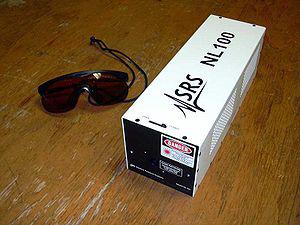
A 337nm wavelength and 170 µJ pulse energy 20 Hz cartridge nitrogen laser
A Nitrogen laser is a gas laser operating in the ultraviolet range (typically 337 nm), using molecular nitrogen as its gain medium, pumped by an electrical discharge.
The wall-plug efficiency of the nitrogen laser is low, typically 0.1% or less, though nitrogen lasers with efficiency of up to 3% have been reported in the literature. The wall-plug efficiency is the product of the following three efficiencies:
• electrical: TEA laser
• gain medium: This is the same for all nitrogen lasers and thus has to be at least 3%
o inversion by electron impact is 10 to 1 due to Franck-Condon principle
o energy lost in the lower laser level: 40 %
• optical: More induced emission than spontaneous emission
Gain medium
The gain medium is nitrogen molecules in the gas phase. The nitrogen laser is a 3-level laser. In contrast to a ruby laser or to other more typical 4-level lasers, the upper laser level of nitrogen is directly pumped, imposing no speed limits on the pump. Pumping is normally provided by direct electron impact; the electrons must have sufficient energy, or
This is a SEO version of Microsoft Word - Journal of Physics.doc. Click here to view full version
« Previous Page Table of Contents Next Page »