This is a SEO version of Microsoft Word - Journal of Physics.doc. Click here to view full version
« Previous Page Table of Contents Next Page »electric arc like discharges called streamers. A mix of a noble gas (up to 0.9) and nitrogen enhance elastic scattering of electrons over electron multiplying and thus widens avalanches and streamers.
Spark gaps use a high density of gas molecules and a low density of initial electrons to favor streamers. Electrons are removed by a slowly rising voltage. A high density gas increases the breakdown field, thus shorter arcs can be used with lower inductance and the capacity between the electrodes is increased. A wide streamer has a lower inductance.
Gas lasers use low density of gas molecules and a high density of initial electrons to prevent streamers. Electrons are added by preionisation not removed by oxygen, because nitrogen from bottles is used. Wide avalanches can excite more nitrogen molecules.
Inelastic scattering heats up a molecule, so that in a second scattering the probability of electron emission is increased. This leads to an arc. Typically arcing occurs after lasing in nitrogen. The streamer in the spark gap discharges the electrodes only by means of image charge, thus when the streamer touches both electrodes most of the charge is still available to feed the arc, additional charge is stored on the distribution plates. Thus arcing in the spark gap starts before lasing.
Reference:
4. J I Levatter and S C Lin, Necessary conditions for the homogeneous formation of pulsed avalanche discharges at high gas pressures , J.Appl.Phys. 51, No2, pp 210 – 222, January 1980.
Electrodynamics
Circuit.
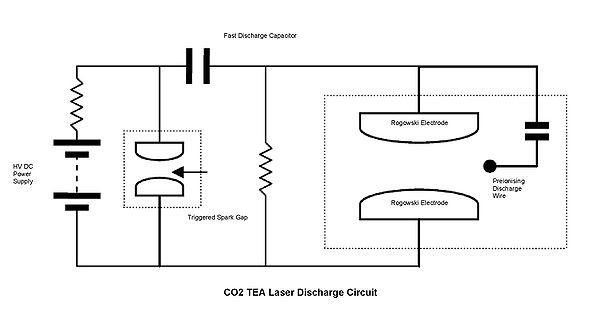
Low inductance implementation cross cut. Erratum: Right cap needs to be bigger.
Low inductance implementation top view. Erratum: Caps should be slightly longer than the channel and have rounded corners.
This is a SEO version of Microsoft Word - Journal of Physics.doc. Click here to view full version
« Previous Page Table of Contents Next Page »