This is a SEO version of Microsoft Word - Journal of Physics.doc. Click here to view full version
« Previous Page Table of Contents Next Page »Carbon dioxide laser
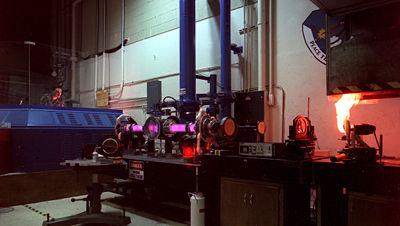
A test target is vaporized and bursts into flame upon irradiation by a high power continuous wave carbon dioxide laser emitting tens of kilowatts of infrared light.
The carbon dioxide laser ( CO
2 laser ) was one of the earliest gas lasers to be developed invented by Kumar Patel of Bell Labs in 1964, and is still one of the most useful. Carbon dioxide lasers are the highest-power continuous wave lasers that are currently available. They are also quite efficient: the ratio of output power to pump power can be as large as 20%.
The CO
2 laser produces a beam of infrared light with the principal wavelength bands centering around 9.4 and 10.6 micrometers.
The active laser medium (laser gain/amplification medium) is a gas discharge which is air cooled (water cooled in higher power applications). The filling gas within the discharge tube consists primarily of:
• Carbon dioxide (CO
2 ) (around 10– 20 %)
• Nitrogen (N
2 ) (around 10–20%)
• Hydrogen (H
2 ) and/or xenon (Xe) (a few percent; usually only used in a sealed tube.)
• Helium (He) (The remainder of the gas mixture)
The specific proportions vary according to the particular laser.
The population inversion in the laser is achieved by the following sequence:
Electron impact excites vibrational motion of the nitrogen. Because nitrogen is a homonuclear molecule, it cannot lose this energy by photon emission, and its excited vibrational evels are therefore metastable and live or a long time.
Collisional energy transfer between he nitrogen and the carbon dioxide molecule causes vibrational excitation of the carbon dioxide, with sufficient efficiency to lead to the desired population inversion necessary for laser operation.
3. The nitrogen molecules are left in a lower excited state. Their transition to ground state takes place by collision with cold helium atoms. The resulting hot helium atoms must be cooled in order to sustain the ability to produce a population inversion in the carbon dioxide molecules. In sealed lasers, this takes place as the helium atoms strike the walls of the container. In flow-through lasers, a continuous stream of CO
2 and nitrogen is excited by the plasma discharge and the hot gas mixture is exhausted from the resonator by pumps.
Construction
Because CO
2 lasers operate in the infrared, special materials are necessary for their construction. Typically, the mirrors are silvered, while windows and lenses are made of either germanium or zinc selenide. For high power applications, gold mirrors and zinc selenide windows and lenses are preferred. There are also diamond windows and even lenses in use. Diamond windows are extremely expensive, but their high thermal conductivity and hardness make them useful in high-power applications and in dirty environments. Optical elements made of diamond can even be sand blasted without losing their optical properties. Historically, lenses and windows were made out of salt (either sodium chloride or potassium chloride). While the material was inexpensive,
This is a SEO version of Microsoft Word - Journal of Physics.doc. Click here to view full version
« Previous Page Table of Contents Next Page »