This is a SEO version of Microsoft Word - Journal of Physics.doc. Click here to view full version
« Previous Page Table of Contents Next Page »the lenses and windows degraded slowly with exposure to atmospheric moisture.
The most basic form of a CO
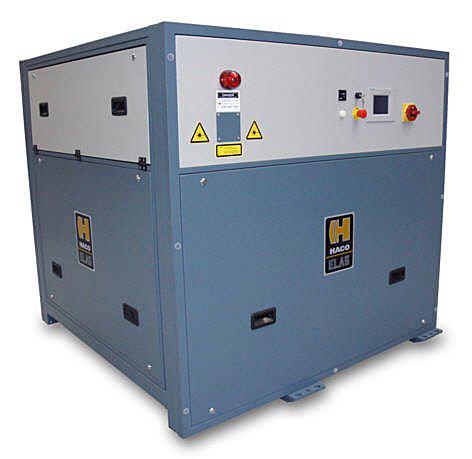
2 laser consists of a gas discharge (with a mix close to that specified above) with a total reflector at one end, and an output coupler (usually a semi-reflective coated zinc selenide mirror) at the output end. The reflectivity of the output coupler is typically around 5-15%. The laser output may also be edge-coupled in higher power systems to reduce optical heating problems.
The CO
2 laser can be constructed to have CW powers between milliwatts (mW) and hundreds of kilowatts (kW). [2] It is also very easy to actively Q-switch a CO
2 laser by means of a rotating mirror or an electro-optic switch, giving rise to Q-switched peak powers up to gigawatts (GW) of peak power.
Because the laser transitions are actually on vibration-rotation bands of a linear triatomic molecule, the rotational structure of the P and R bands can be selected by a tuning element in the laser cavity. Because transmissive materials in the infrared are rather lossy, the frequency tuning element is almost always a diffraction grating. By rotating the diffraction grating, a particular rotational line of the vibrational transition can be selected. The finest frequency selection may also be obtained through the use of an etalon. In practice, together with isotopic substitution, this means that a continuous comb of frequencies separated by around 1 cm −1 (30 GHz) can be used that extend from 880 to 1090 cm −1 . Such "line-tuneable" carbon dioxide lasers are principally of interest in research applications.
Applications
Because of the high power levels available (combined with reasonable cost for the laser), CO
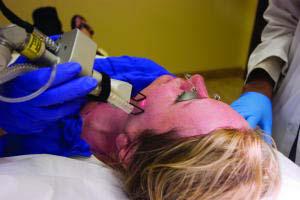
2 lasers are frequently used in industrial applications for cutting and welding, while lower power level lasers are used for engraving. They are also very useful in surgical procedures because water (which makes up most biological tissue) absorbs this frequency of light very well. Some examples of medical uses are laser surgery, skin
resurfacing ("laser facelifts") (which essentially consist of burning the skin to promote collagen formation), and dermabrasion. Also, it could be used to treat certain skin conditions such as hirsuties papillaris genitalis by removing embarrassing or annoying bumps, podules, etc. Researchers in Israel are experimenting with using CO
2 lasers to weld human tissue, as an alternative to traditional sutures.
The common plastic Poly (methyl methacrylate) (PMMA) absorbs IR light in the 2.8–25 µm wavelength band, so CO
2 lasers have been used in recent years for fabricating microfluidic devices from it, with channel widths of a few hundred micrometers.
Because the atmosphere is quite transparent to infrared light, CO
2 lasers are also used for military rangefinding using LIDAR techniques.
This is a SEO version of Microsoft Word - Journal of Physics.doc. Click here to view full version
« Previous Page Table of Contents Next Page »