This is a SEO version of Microsoft Word - Journal of Physics.doc. Click here to view full version
« Previous Page Table of Contents Next Page »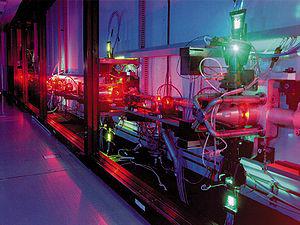
An atomic vapor laser isotope separation experiment at LLNL. Green light is from a copper vapor pump laser used to pump a highly tuned dye laser which is producing the orange light.
A dye laser is a laser which uses an organic dye as the lasing medium, usually as a liquid solution. Compared to gases and most solid state lasing media, a dye can usually be used for a much wider range of wavelengths. The wide bandwidth makes them particularly suitable for tunable lasers and pulsed lasers. Moreover, the dye can be replaced by another type in order to generate different wavelengths with the same laser, although this usually requires replacing other optical components in the laser as well.
Dye lasers were independently discovered by P. P. Sorokin and F. P. Schäfer (and colleagues) in 1966.
Construction
A dye laser consists of an organic dye mixed with a solvent, which may be circulated through a dye cell, or streamed through open air using a dye jet. A high energy source of light is needed to "pump" the liquid beyond its lasing threshold. A fast discharge flashlamp or an external laser is usually used for this purpose. Mirrors are also needed to oscillate the light produced by the dye’s fluorescence, which is amplified with each pass through the liquid. The output mirror is normally around 80% reflective, while all other mirrors are
usually more than 99% reflective. The dye solution is usually circulated at high speeds, to help avoid triplet absorption and to decrease degradation of the dye. A prism or diffraction grating is usually mounted in the beam path, to allow tuning of the beam.
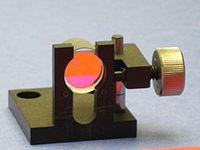
A dielectric mirror used in a dye laser.
Because the liquid medium of a dye laser can fit any shape, there are a multitude of different configurations that can be used. A Fabry-Perot laser cavity is usually used for flashlamp pumped lasers, which consists of two mirrors, which may be flat or curved, mounted parallel to each other with the laser medium in between. The dye cell is usually side-pumped, with one or more flashlamps running parallel to the dye cell in a reflector cavity. The reflector cavity is often water cooled, to prevent thermal shock in the dye caused by the large amounts of near-infrared radiation which the flashlamp produces. Axial pumped lasers have a hollow, annular-shaped flashlamp that surrounds the dye cell, which has lower inductance for a shorter flash, and improved transfer efficiency. Coaxial pumped lasers have an annular dye cell that surrounds the flash lamp, for even better transfer efficiency, but have a lower gain due to diffraction losses. Flash pumped lasers can only be used for pulsed output.
This is a SEO version of Microsoft Word - Journal of Physics.doc. Click here to view full version
« Previous Page Table of Contents Next Page »