This is a SEO version of Microsoft Word - Journal of Physics.doc. Click here to view full version
« Previous Page Table of Contents Next Page »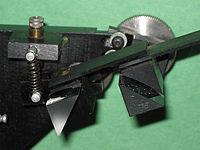
Multiple prisms are often used to tune the output of a dye laser
A ring laser design is often chosen for continuous operation, although a Fabry-Perot design is sometimes used. In a ring laser, the mirrors of the laser are positioned to allow the beam to travel in a circular path. The dye cell, or cuvette, is usually very small. Sometimes a dye jet is used to help avoid reflection losses. The dye is usually pumped with an external laser, such as a nitrogen, excimer, or frequency doubled Nd:YAG laser. The liquid is circulated at very high speeds, to prevent triplet absorption from cutting off the beam. Unlike Fabry-Perot cavities, a ring laser does not generate standing waves which cause spatial hole burning, a phenomenon where energy becomes trapped in unused portions of the medium between the crests of the wave. This leads to a better gain from the lasing medium.
Operation
The dyes used in these lasers contain rather large organic molecules which fluoresce when exposed to the proper frequency of light. Dyes will emit stimulated radiation when the molecules are in their singlet state. In this state, the molecules emit light via fluorescence, and the dye is quite clear to the lasing wavelength. Within a microsecond, or less, the molecules will change to their triplet state. In the triplet state, light is emitted via phosphorescence, and the molecules begin to absorb the lasing wavelength, making the dye opaque. Liquid dyes also have an extremely
high lasing threshold. Flashlamp pumped lasers need a flash with an extremely short duration, to deliver the large amounts of energy necessary to bring the dye past threshold before triplet absorption overcomes singlet emission. Dye lasers with an external pump laser can direct enough energy of the proper wavelength into the dye with a relatively small amount of input energy, but the dye must be circulated at high speeds to keep the triplet molecules out of the beam path.
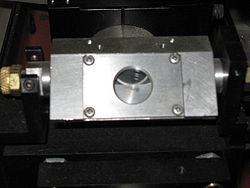
A cuvette used in a dye laser
Since organic dyes tend to degrade under the influence of light, the dye solution is normally circulated from a large reservoir. The dye solution can be flowing through a cuvette, i.e., a glass container, or be as a dye jet , i.e., as a sheet-like stream in open air from a specially-shaped nozzle. With a dye jet, one avoids reflection losses from the glass surfaces and contamination of the walls of the cuvette. These advantages come at the cost of a more-complicated alignment. Dye lasers emission is inherently broad. In order to produce narrow bandwidth tuning these lasers use many types of cavities and resonators which include gratings, prisms, and etalons.
Liquid dyes are very high gain laser mediums. The beam only needs to make a few passes through the liquid for high gains in power, and hence, the high transmittance of the output coupler. This high gain nature also leads to very high losses, as any reflections generated by the dye cell walls, or flashlamp
This is a SEO version of Microsoft Word - Journal of Physics.doc. Click here to view full version
« Previous Page Table of Contents Next Page »