This is a SEO version of Microsoft Word - Journal of Physics.doc. Click here to view full version
« Previous Page Table of Contents Next Page »reflector, will dramatically reduce the amount of energy available to the beam. Pumping cavities are often coated, anodized, or otherwise made of a material that will absorb the lasing wavelength while effectively reflecting the pumping energy.
Chemicals used
Rhodamine 6G Chloride powder; mixed with methanol; emitting yellow light under the influence of a green laser
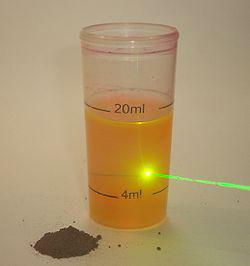
Some of the dyes are rhodamine, fluorescein, coumarin, stilbene, umbelliferone, tetracene, malachite green, and others. While some dyes are actually used in food coloring, most dyes are very toxic, and often carcinogenic. Many dyes, such as rhodamine 6G, (in its chloride form), can be very corrosive to all metals except stainless steel.
A wide variety of solvents can be used, although some dyes will dissolve better in some solvents than in others. Some of the solvents used are water, glycol, ethanol, methanol, hexane, cyclohexane, cyclodextrin, and many others. Solvents are often highly toxic, and can sometimes be absorbed directly through the skin, or through inhaled vapors. Many solvents are also extremely flammable.
Adamantane is added to some dyes to prolong their life.
Cycloheptatriene and cyclooctatetraene (COT) can be added as triplet quenchers for rhodamine G, increasing the laser output power. Output power of 1.4 kilowatt at 585 nm was achieved using Rhodamine 6G with COT in methanol-water solution.
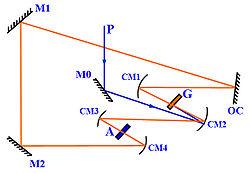
A ring dye laser. P-pump laser beam; G-gain dye jet; A-saturable absorber dye jet; M0, M1, M2-planar mirrors; OC–output coupler; CM1 to CM4-curved mirrors.
Ultra-short optical pulses
R. L. Fork, B. I. Greene, and C. V. Shank have demonstrated, in 1981, the generation of ultra-short laser pulse using a ring-dye laser (or dye laser exploiting colliding pulse mode-locking). Such kind of laser is capable of generating laser pulses of ~ 0.1 ps duration.
Applications
Dye lasers are very versatile. In addition to their recognized wavelength agility these lasers can offer very large pulsed energies or very high average powers. Flashlamp-pumped dye lasers have been shown to yield hundreds of Joules per pulse and copper-laser-pumped dye lasers are known to yield average powers in the kilowatt regime.
Dye lasers are used in many applications including:astronomy (as laser guide stars),
• atomic vapor laser isotope separation
• manufacturing
• medicine
• spectroscopy.
This is a SEO version of Microsoft Word - Journal of Physics.doc. Click here to view full version
« Previous Page Table of Contents Next Page »