This is a SEO version of Microsoft Word - Journal of Physics.doc. Click here to view full version
« Previous Page Table of Contents Next Page »
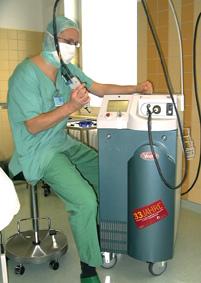
In laser medicine these lasers are applied in several areas, including dermatology where they are used to make skin tone more even. The wide range of wavelengths possible allows very close matching to the absorption lines of certain tissues, such as melanin or hemoglobin, while the narrow bandwidth obtainable helps reduce the possibility of damage to the surrounding tissue. They are used to treat port-wine stains and other blood vessel disorders, scars and kidney stones. They can be matched to a variety of inks for tattoo removal, as well as a number of other applications.
In spectroscopy, dye lasers can be used to study the absorption and emission spectra of various materials. Their tunability, (from the near-infrared to the near-ultraviolet), narrow bandwidth, and high intensity allows a much greater diversity than other light sources. The variety of pulse widths, from ultra-short, femto-second pulses to continuous-wave operation, makes them suitable for a wide range of applications, from the study of fluorescent lifetimes and semiconductor properties to lunar laser ranging experiments.
This is a SEO version of Microsoft Word - Journal of Physics.doc. Click here to view full version
« Previous Page Table of Contents Next Page »